
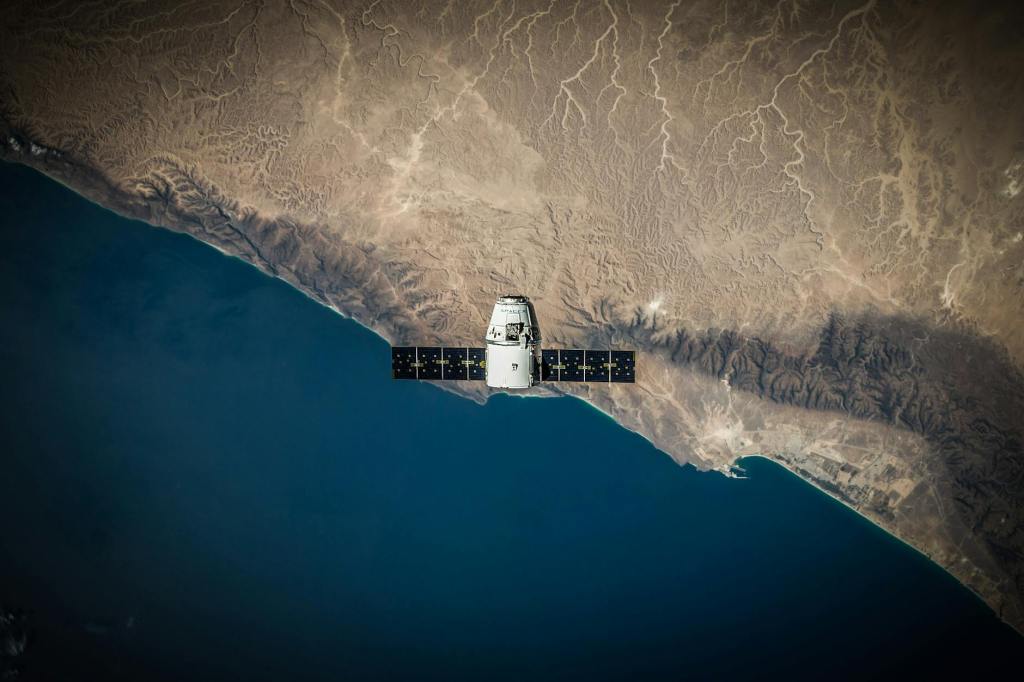
In the face of global climate change, one of the most powerful tools for understanding our planet is orbiting far above it. Satellite remote sensing—the use of satellites to collect data about Earth’s surface and atmosphere—has become a cornerstone of modern environmental science. By integrating physics, geoscience, computer science, and environmental studies, this interdisciplinary field allows scientists to monitor changes in real time across the globe.
At its core, remote sensing uses principles of physics, particularly optics and electromagnetic radiation, to gather information about Earth. Satellites detect the reflection or emission of radiation from the Earth’s surface and atmosphere in various wavelengths—visible, infrared, microwave, and more. These signals are then processed and translated into data maps and images that help researchers understand phenomena like sea level rise, deforestation, ocean temperature, and polar ice melt.
One major application of satellite sensing is tracking changes in Earth’s cryosphere—the frozen water parts of the planet, including glaciers, ice sheets, and sea ice. Missions like NASA’s ICESat-2 use laser altimetry to measure the elevation of ice surfaces with centimeter-level accuracy. This data reveals how rapidly ice is melting in regions like Greenland and Antarctica, contributing to global sea level rise.
Satellites are also crucial in monitoring atmospheric gases. Instruments like NASA’s OCO-2 and the European Space Agency’s Sentinel-5P measure carbon dioxide, methane, and ozone concentrations around the world. These measurements provide critical insights into greenhouse gas sources and sinks, helping scientists model climate scenarios and verify international emission reduction efforts.
Another vital application is land use and vegetation monitoring. Sensors such as Landsat and MODIS have been capturing high-resolution images of Earth’s surface for decades. These datasets allow researchers to observe trends in deforestation, urban expansion, desertification, and agricultural patterns—all key drivers or consequences of climate change. In recent years, machine learning techniques have been applied to satellite data to automate detection of environmental changes over large areas.
Additionally, satellite observations support early warning systems for natural disasters linked to climate change, including wildfires, droughts, and hurricanes. By providing near real-time information on weather conditions, soil moisture, and vegetation dryness, satellites enable better preparedness and response strategies for vulnerable communities.
However, interpreting satellite data requires a multidisciplinary approach. Environmental scientists must collaborate with physicists, data analysts, computer scientists, and policymakers to ensure that the data collected is accurate, meaningful, and actionable. Challenges like cloud cover, data resolution, and sensor calibration must be addressed to maintain scientific integrity.
As the climate crisis intensifies, the demand for precise, large-scale, and long-term environmental monitoring will only grow. Satellite remote sensing offers an unparalleled vantage point—both literally and scientifically—to understand and respond to Earth’s changing systems. By uniting the rigor of physical science with the urgency of environmental action, this technology exemplifies how interdisciplinary STEM research can illuminate the path to a more sustainable future.
 The STEMisphere Journal
Leave a comment